

Model example · fictional brief and source documents
Residential development review
Financial model, access rights and conditions to resolve before buying land.
Go to the conclusion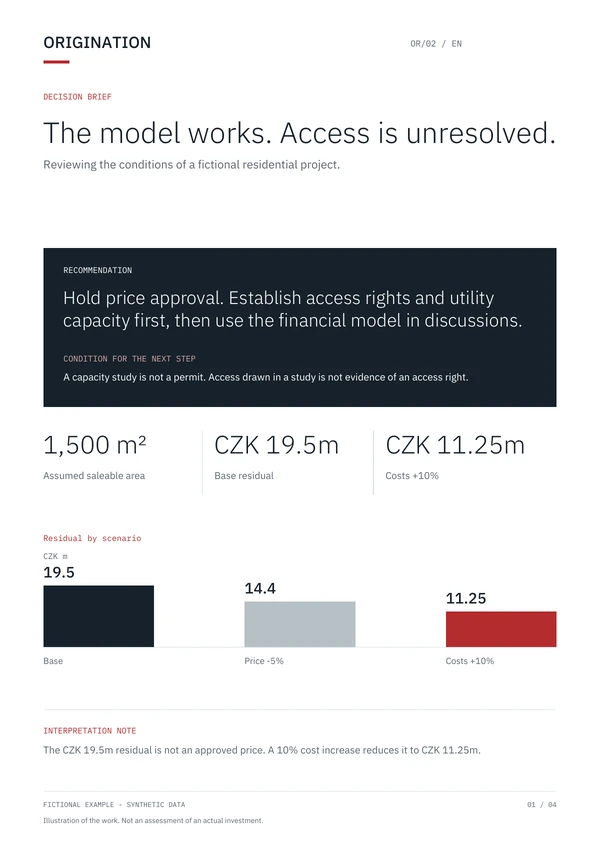
What must be evidenced before discussing the land price?
Hold price approval. Establish access rights and utility capacity first, then use the financial model in discussions.
- The decisive finding
- The study assumes access over a separate strip R. The synthetic rights schedule contains neither an agreement nor consent for it.
- Impact
- The CZK 19.5m residual is not an approved price. A 10% cost increase reduces it to CZK 11.25m.
- The remaining condition
- A capacity study is not a permit. Access drawn in a study is not evidence of an access right.
Revenue − costs − contingency − selected profit
Before acquisition costs and excluded taxes. A different scenario does not resolve permissions or access.
Evidence and calculations
Fictional demonstration with synthetic source documents. Site B and access strip R are not real parcels. We examine the connection between capacity, rights and economics. Prices, areas and budget are model inputs, not market observations or a property valuation.
| Scenario | Revenue | Costs | Contingency | Profit | Residual | Source |
|---|---|---|---|---|---|---|
| Base | CZK 120m | CZK 75m | CZK 7.5m | CZK 18m | CZK 19.5m | P-S04 |
| Price −5% | CZK 114m | CZK 75m | CZK 7.5m | CZK 17.1m | CZK 14.4m | P-S04 |
| Costs +10% | CZK 120m | CZK 82.5m | CZK 8.25m | CZK 18m | CZK 11.25m | P-S04 |
Records shown: 3
P-F01 / Synthetic input
Area is a study assumption.
The study assumes 1,500 m² of saleable area. It includes neither an issued permit nor confirmed binding areas. The economics therefore describe a scenario, not approved capacity.
P-S01 · Section 1 / capacity ↓P-F02 / Open question
Access is the decisive open condition.
Access crosses the separate strip R. The rights schedule has no agreement or consent for its use. The drawing cannot establish that access is secured.
P-S02 · Row R / access ↓P-F03 / Calculation
Revenue does not substantiate the sale price.
1,500 × CZK 80,000 = CZK 120m. CZK 80k/m² is an input assumption without comparable sales. It needs separate validation before a pricing conclusion.
P-S04 · Section 1 / revenue ↓P-F04 / Calculation
The contingency has a defined basis.
Costs excluding land total CZK 75m. The 10% contingency applies to these costs, not revenue, giving CZK 7.5m in the base case. The budget excludes land purchase and acquisition expenses.
P-S03 · Sections 1–2 / budget and exclusions ↓P-F05 / Calculation
An acceptable price depends on the scenario.
Base: 120 − 75 − 7.5 − 18 = CZK 19.5m. Price −5% gives CZK 14.4m; costs +10% give CZK 11.25m. Contingency and profit are recalculated under the same rules in every scenario.
P-S04 · Section 2 / sensitivity ↓P-F06 / Analyst interpretation
The next checks have an order.
Check access and utility capacity first, then confirm area and budget. The rights schedule includes neither capacity statements nor a permit. Choosing a sale price first would not resolve those conditions.
P-S02 · Rows S and P / utilities and permit ↓Supporting source material
We created these documents for this fictional scenario. They support findings within the example and do not establish facts about a real company, investor or property.
P-S01 / 2026-09-01Synthetic capacity study
Synthetic document · Sections 1–2 / schematic
Synthetic document. Site B: model residential project with 1,500 m² of saleable floor area. The schematic marks development area B, separate access strip R and utility connection point S. Access across R is a study assumption. The document confirms neither strip ownership, usage rights, utility capacity nor an issued permit. It is not a real map or design document; area B is not the saleable floor area.
P-S02 / 2026-09-01Synthetic rights and conditions schedule
Synthetic document · Rows B, R, S and P
Synthetic document. B: main area assumed held by Owner B; acquisition evidence is outside the sample. R: separate access strip outside Owner B’s assumed ownership; no usage agreement or consent attached. S: connection capacity and connection cost unconfirmed. P: no issued permit attached. Schedule conclusion: the study assumes a solution that the available synthetic rights packet does not yet evidence.
P-S03 / 2026-09-01Synthetic project budget
Synthetic document · Sections 1–2
Synthetic document. Costs excluding land in CZK m: construction 58; design and preparation 8; financing 4; selling 3; coordination and connections 2. Total 75. Contingency is added separately at 10% of these costs. Connections are assumed, not contractually confirmed. Land, acquisition expenses and unmodelled taxes must be deducted from the residual. All amounts are modelled excluding VAT. A drawdown schedule is not evidenced.
P-S04 / 2026-09-01Revenue and sensitivity model
Synthetic document · Sections 1–2
Synthetic document. Inputs: area 1,500 m², price CZK 80,000/m² excluding VAT; no comparable sales attached. Model owner’s profit requirement: 15% of revenue. Residual = revenue − costs − 10% of costs − 15% of revenue. Base: 120 − 75 − 7.5 − 18 = CZK 19.5m. Price −5%: 114 − 75 − 7.5 − 17.1 = 14.4. Costs +10%: 120 − 82.5 − 8.25 − 18 = 11.25.
Checks before the next step
- 01
Evidence access and utility connections.
Owner: Legal and technical teams
Evidence to close: Document supporting use of strip R, confirmed utility capacity and connection-cost scope.
- 02
Confirm capacity and budget.
Owner: Designer and cost planner
Evidence to close: Evidenced areas, planning status and a budget with the same cost boundaries as the model.
- 03
Recalculate the discussion limit.
Owner: Investor and analyst
Evidence to close: Validated revenue, cost and tax inputs; agreed contingency, profit requirement and conditions of any offer.
Discuss your brief
We will discuss your criteria and available evidence, then propose specific deliverables, timing and a fixed fee. The first consultation is free.